

Al-Ghazali, qahr, and the fight not to become what wounds us.
A Palestinian friend recently shared with me a reflection on the Arabic word qahr.
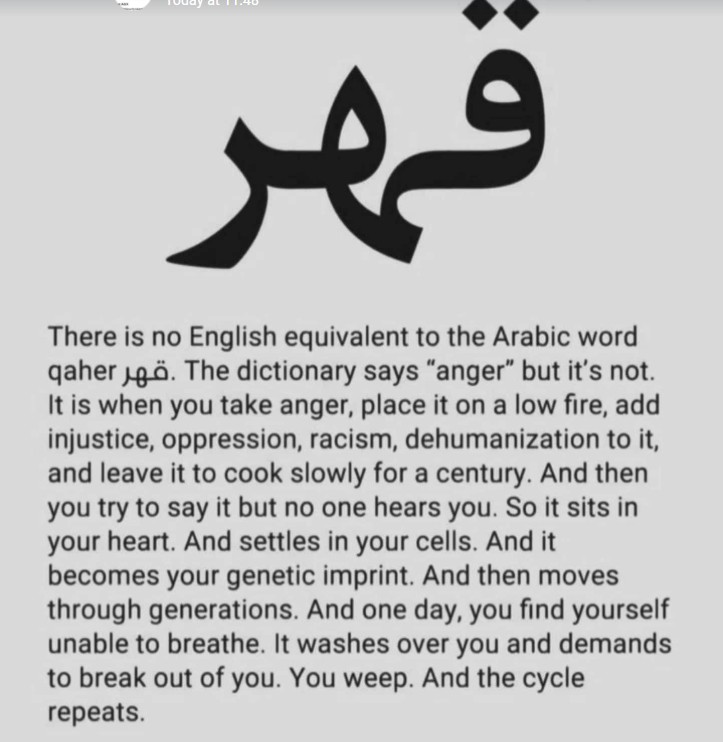
Not simple anger. Not even grief. Something heavier: the inner compression produced when anger is held under pressure for too long, mixed with humiliation, injustice, silencing and dehumanization, until it no longer feels like an emotion passing through you but something that settles into the heart.
I write this with caution. I have lived in Palestine for months, not generations. I do not pretend to explain a people’s wound from the outside. What I can do is listen, receive what friends here entrust to words, and place beside it one older moral vocabulary that may help some readers think more honestly about what prolonged injustice does to the human soul.
Reading that reflection, I thought of Abu Hamid al-Ghazali (1058–1111), one of the great thinkers of the Islamic tradition: jurist, theologian and spiritual guide. He wrote deeply about the heart, its wounds, its illusions, its anger and its desires, and about the difficult work of keeping the inner life aligned before God.
He did not write about Palestine as we know it today. But he wrote about the heart under pressure, and that is why he still matters.
More than anger
What struck me in that reflection on qahr is that it names something beyond rage. Rage still has movement in it. It rises, strikes, speaks. Qahr feels more like being overpowered. Your voice does not land. Your dignity is denied. The injury does not end when the event ends, because it continues by living inside you.
Al-Ghazali knew that the heart can be darkened by repeated distortion. He described it as something made to perceive truth, yet capable of becoming clouded or veiled. That matters, because oppression does not only destroy homes, bodies and futures. It also tries to colonize the inner world. It pushes the soul toward hatred, numbness, humiliation or endless reaction.
That is one of evil’s deepest ambitions: not only to wound you, but to recruit you.
Readers from a Christian background may hear an echo here too. In Augustine, there is a similar concern with the inner life: with the heart becoming disordered, with passions taking the wrong place, and with the need for the soul to be rightly ordered rather than ruled by anger, pride or injury.
Anger is not the enemy
Al-Ghazali was not naïve. He did not teach that anger should simply disappear. Anger has a purpose. It protects. It resists. It refuses humiliation. A person who feels no anger in the face of injustice is not more holy; he may simply be asleep.
But the question is whether anger remains under wise rule, or whether it takes the throne. Once anger governs the self, it starts to deform judgment. It narrows the world. It tempts the wounded to become inwardly organized by the very violence they suffer.
So the challenge is not to kill anger. It is to keep it from becoming your master.
The occupation of the soul
A military occupation occupies land, movement, institutions and futures. But prolonged injustice seeks another occupation too: that of the imagination, the nervous system and the heart. It wants people either crushed into submission or consumed by hatred. Both outcomes serve power.
That is why inner work is not a luxury. It is not a retreat from reality. It can be part of moral survival.
To say this clearly: spiritual discipline is not a substitute for justice. It does not excuse the oppressor, and it does not make resistance unnecessary. It asks something harder: how do we resist evil without letting evil set the final shape of our inner life?
Practices of harmony
Al-Ghazali believed the heart must be trained, especially under pressure.
One practice that still speaks strongly now is breath joined to remembrance. When the heart feels physically tight, when pressure is not only moral but bodily, one can breathe in slowly, breathe out more slowly, and with the out-breath quietly repeat:
La hawla wa la quwwata illa billah
There is no power and no strength except through God.
This is not passivity. It is a refusal to carry alone what would crush any human being. It interrupts panic’s claim to totality. It reminds the body that the soul need not mirror the violence around it.
Al-Ghazali also valued silence and withdrawal, not as escape from the world, but as protection from constant reactivity. In times like these, many of us consume pain continuously: headlines, images, arguments, humiliations layered on humiliations. Bearing witness matters. But constant exposure can produce moral exhaustion without moral clarity.
A few minutes of silence, prayer, walking, or simply looking at the sky may sound small against history. But it is one way of refusing total capture.
He also urged the reader to remember scale. Empires act as if they are permanent. They are not. Humiliation feels endless. It is not. Power always pretends to be reality itself. It is not.
A lesson for now
There is a temptation, when facing something as bloody and morally disfiguring as the ongoing occupation of Palestine, to think there are only two options left: numbness or fury.
Al-Ghazali suggests a third.
Not numbness, because injustice must be named.
Not fury as identity, because the soul cannot live forever on acid.
But disciplined moral fire: grief that does not become self-destruction, anger that does not become mimicry of the oppressor, remembrance that keeps the heart alive when the world wants it deadened.
One of the deepest victories of oppression would be this: that those who suffer it, or those who witness it, come to believe brutality is the only serious language left.
Al-Ghazali says otherwise.
For those who feel crushed
To those who feel pressed down by history, silenced by power, or slowly altered by repeated injustice: your pain is not trivial, and it is not your shame.
But take care of what that pain is turning you into.
Oppression wants more than submission. It wants inheritance. It wants to pass through generations not only as memory, but as poison. That is why liberation must also include the work of the heart: protecting the inward place where dignity, truth and mercy still live.
In that sense, Al-Ghazali still speaks with force today. Not because he offers an escape from history, but because he reminds us that even under pressure, the soul must not surrender its shape to injustice.
 Bart Vander Plaetse
Leave a comment