

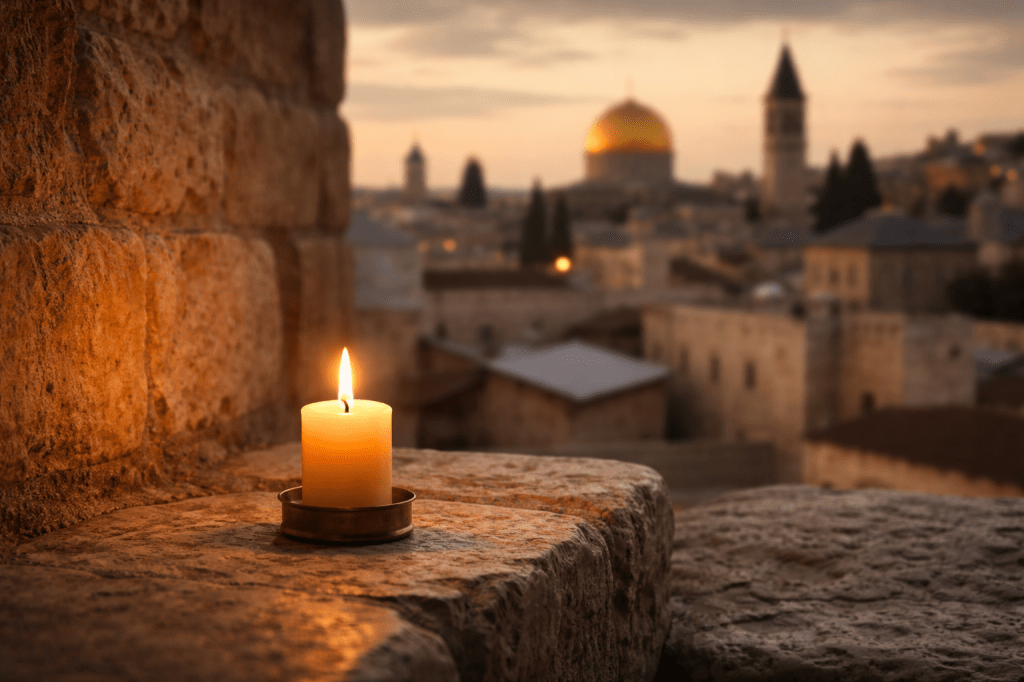
From Jerusalem, between two Easters, a reflection on ritual, conscience, and the danger of looking away
This year, for the first time in my life, I get two Easters.
One today.
One next weekend.
Western Christians celebrate Easter now. Orthodox Christians celebrate the week after. And strangely, that double rhythm feels right for this moment. As if one reminder of renewal were not enough. As if we need to hear it twice before it can break through the noise.
Because the noise is immense.
I write this from Jerusalem, where the season of holy days unfolds not in abstraction, but in the shadow of war, deepening occupation, and the daily oppression of Palestinians. The occupation I mean is not vague. It is the long and hardening occupation of Palestine: of land, of movement, of dignity, of political horizon. And increasingly, it is accompanied by a language and practice of power that has become more open, more aggressive, and more morally unrestrained.
So this year, I cannot simply say “Happy Easter” in the usual way.
I want to pause over what these rituals are actually trying to tell us.
And this reflection is not only for believers. Atheists, agnostics and secular humanists also live by principles, rhythms and rituals — whether they call them that or not. Shared meals. Commemorations. Moments of silence. Anniversaries. Habits of care. Ethical boundaries. Stubborn acts of solidarity. We all seem to need ways of remembering what matters, of marking loss and renewal, of calling ourselves back to something larger than appetite, fear or tribe.
So the question, for me, is larger than religion alone: how did we become so good at the language of meaning, conscience and values, and so bad at living their moral demands?
Easter is not just a spring festival
For Christians, Easter is not one cheerful Sunday dropped into spring.
It is the culmination of a whole arc of rituals meant to bring the believer through triumph, intimacy, suffering, silence and finally renewal.
Palm Sunday begins with the crowd welcoming Jesus into Jerusalem with palms and acclaim. But even there, the ritual already contains a warning: public enthusiasm is fickle, and the same crowd that celebrates can quickly turn.
Maundy Thursday remembers the Last Supper, but also the washing of the disciples’ feet. That matters. At the heart of Christian power is supposed to be humility, service, and radical love — not domination dressed up as righteousness.
Good Friday is the brutal centre of it all. The cross is not an ornament. It is not soft spirituality. It is the exposure of state violence, mob cowardice, injustice, humiliation, abandonment. Christians venerate the cross not because suffering is good, but because God is revealed inside what empires do to the vulnerable.
Then comes Holy Saturday — that strange day of waiting, grief and silence. No triumph yet. No neat resolution. Just the unbearable space between devastation and hope.
And then Easter: candlelight, proclamation, bells, flowers, white cloth, alleluia, empty tomb. Death does not get the last word. Despair is not final. Renewal is possible.
That is the Christian claim.
Not that suffering is absent.
Not that evil is mild.
But that life can break through it.
And if that is what Easter means, then it cannot remain a decorative ritual. It has to become a moral challenge.
Passover asks another question: do not become Pharaoh
At almost the same time, Jewish families are living through Passover.
At the Seder table, the Exodus story is retold in ritual form. Matzah recalls the haste of liberation. Maror recalls bitterness and oppression. The Haggadah structures memory so that freedom is not treated as abstraction, but as something earned through suffering and never to be taken for granted.
Passover, at its deepest, is not only about remembering that “we were once slaves.”
It is also about the moral responsibility that should follow from that memory.
To know oppression should make one more alert to oppression.
To remember bondage should make one less capable of justifying domination.
That, surely, is part of the point.
Muslims, too, are moving through a moral season
Muslims have just come through Eid al-Fitr, after the discipline of Ramadan: fasting, prayer, self-restraint, almsgiving, gratitude, and renewed awareness of dependence on God.
But the spiritual movement does not stop there.
It already points toward the season that will lead to the second Eid, Eid al-Adha: sacrifice, submission, generosity, and the duty to share what one has with others — especially those with less.
So here too, the rhythm is not just festive.
It is moral formation.
It asks: what has fasting changed in you?
What has prayer softened?
What has gratitude made you less entitled to?
What has worship made you more responsible for?
And yet look around
This is what unsettles me.
At exactly the moment when Jews, Christians and Muslims are surrounded by rituals of liberation, sacrifice, humility, renewal and mercy, public life feels saturated with the opposite.
And frankly, this is not only a religious failure. It is a human one.
Even those who reject religion often speak sincerely of dignity, justice, human rights, decency, equality, reason. So the scandal is wider than hypocrisy in faith communities. It is the broader human capacity to surround ourselves with values — sacred or secular — and still tolerate cruelty when it becomes politically convenient, tribally rewarding, or simply habitual.
Not restraint, but escalation.
Not humility, but arrogance.
Not truth, but spectacle.
Not moral seriousness, but tribal performance.
I find myself asking: where does the mismatch come from?
How do we perform rituals of freedom while tolerating domination?
How do we speak of sacrifice while worshipping power?
How do we proclaim the dignity of life while making cruelty more bureaucratic, more normalized, more legal?
That question feels especially unavoidable here, in Jerusalem.
Because while holy days call people back to conscience, the political reality keeps moving in the other direction: toward deeper occupation, harsher oppression, wider dehumanisation, and a more shameless normalization of Palestinian dispossession.
The recent hardening of language and policy around the occupation of Palestine is part of that descent. So too is Israel’s new law, passed on 30 March, making death by hanging the default sentence for Palestinians convicted in military courts of deadly attacks. The measure has been condemned as discriminatory and as a step backwards from international legal norms. A society does not become more moral by making punishment more absolute. It becomes more dangerous when vengeance is recoded as virtue and execution is presented as seriousness.
And if we are honest, responsibility does not stop with those driving this descent.
It must also reach those who keep adjusting themselves to it.
The countries that issue careful statements while continuing business as usual.
The leaders who know perfectly well what they are looking at, yet prefer caution over courage.
The public figures who always seem to find one more reason to delay clear speech.
The decent people who do not endorse the injustice, but keep accommodating it.
One of the oldest moral failures is not only to do wrong, but to look away while wrong hardens into normality.
Oppression does not survive on brutality alone. It also survives on diplomatic throat-clearing, selective outrage, procedural delay, and the comforting fiction that silence is neutrality.
It is not.
There comes a point when silence stops being prudence and becomes participation.
Not the same participation as those inflicting the harm. But participation nonetheless.
A respectable form of moral surrender.
And perhaps this is where the season should unsettle us most: rituals of conscience are empty if they do not make us more truthful, more courageous, and less willing to adapt ourselves to the unacceptable.
If renewal means anything in public life, then it must also mean this: refusing euphemism, resisting dehumanisation, and recovering the courage to call injustice by its name.
This is not only local
But this moral corrosion is not confined to this region.
What we see here in sharpened form — tribal loyalty over truth, power defended through spectacle, cruelty normalized through language, silence rewarded as prudence — is part of a wider sickness.
That is why the Trump-era spectacle belongs in this reflection too.
Not because everything becomes America. And not because the situations are identical. They are not.
But because Trump has become one of the clearest global symbols of a politics in which shamelessness becomes strength, incoherence becomes performance, and moral seriousness is replaced by spectacle backed by loyal tribes.
I remain genuinely bewildered by how unhinged, illogical, shameless and chaotic it can be — and by how much public religious support still gathers around it. I see praying evangelicals defending behaviour that seems so radically at odds with the humility, truthfulness and moral seriousness they claim to cherish.
And even beyond religious support, there is something deeply disorienting in the public normalization of it all: the endless excuses, the tactical silences, the shrugging adaptation to conduct that should still shock people.
I do not say this lightly.
But there are moments when the fusion of piety and public moral collapse feels so grotesque that it provokes not only disagreement, but something close to physical revulsion.
Not because faith is the problem.
Because faith — like any system of meaning — emptied of self-critique becomes a costume for power.
And because public morality decays not only through fanatics, but through millions of smaller surrenders: the excuse, the rationalisation, the silence, the decision to move on when something still deserves resistance.
Maybe the real test is whether ritual still judges us
Maybe that is the real question for this season.
Not whether we still know how to perform the rituals.
Clearly, we do.
The question is whether the rituals still have the power to interrupt us.
Does Easter still confront violence, empire and abandonment — or has it become spring imagery and family brunch?
Does Passover still warn us not to become what once oppressed us?
Do Ramadan and Eid still shape humility, restraint and generosity — or do they remain safely enclosed in private devotion while public life runs on force?
And for those outside religion altogether: do our secular ethics, civic ideals and humanist values still demand anything costly from us — or have they too become vocabulary without consequence?
Do these rituals, habits and moral languages still give us the courage to speak when silence becomes complicity?
These are not abstract questions.
They are political questions. Moral questions. Human questions.
And I ask them not from above anyone else, but from within the same confusion.
I am not writing as someone who has figured it out.
I am writing as someone who is bewildered by the daily contrast between sacred words and profane realities.
But bewilderment is not enough.
At some point it has to mature into witness. Into refusal. Into speech.
So yes, happy Easter. But not cheaply.
So yes: happy Easter.
Happy Easter today.
And next weekend again.
And meaningful Passover.
And a belated Eid, with the road already opening toward the next one.
And perhaps also, for those outside faith, a moment to reclaim whatever practices, principles or acts of conscience help keep us human.
But perhaps the real dignity of these sacred days — and of our secular moral vocabularies too — lies not in how beautifully they decorate our calendars.
Perhaps it lies in whether they still expose us.
Whether they still force us to ask what in us has not yet been converted.
What cruelty have we learned to call necessity?
What domination have we dressed up as order?
What lies have we accepted because they flatter our tribe?
What suffering have we made room for inside our moral vocabulary?
And where, precisely, have we chosen silence because speech might cost us something?
If renewal means anything, it must mean more than sentiment.
It must mean becoming harder to recruit into madness.
It must mean becoming harder to silence.
 Bart Vander Plaetse
Leave a comment