

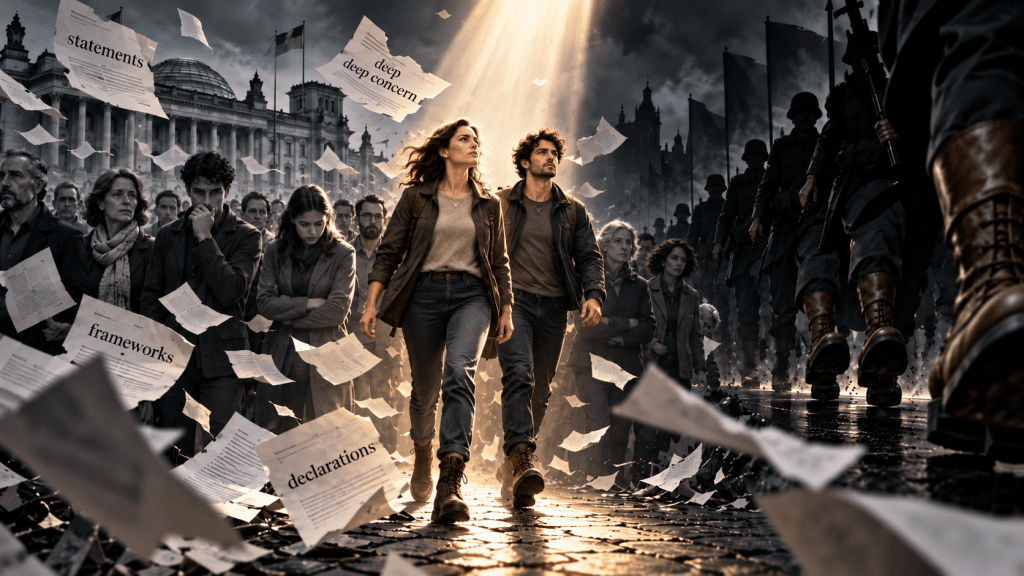
I had one of those moments this morning where five completely different news stories suddenly looked like the same story. European diplomats attacked while accompanying Palestinians during the olive harvest in the West Bank. Governments gathering again to promise that they will protect biodiversity. International financial institutions again saying vulnerable countries need more support. Technology companies again promising that artificial intelligence will be safe. And our oceans quietly changing underneath all of this.Different countries. Different institutions. Different problems. But the same uncomfortable question kept coming back to me:
When are we finally going to stop talking and start doing?
We are becoming world champions in declarations.We condemn. We reaffirm. We call upon. We express deep concern. We launch frameworks. We establish working groups. We organise conferences. We produce another declaration saying that the declaration from four years ago must now urgently be implemented.And afterwards?Too often, remarkably little changes.This weekend, Palestinian civilians, European diplomats and a French mayor were attacked near Taybeh in the occupied West Bank. Belgium’s consul general was among the diplomatic representatives targeted, and a Belgian diplomatic vehicle was damaged. Belgium’s Foreign Minister Maxime Prévot condemned the attack and called for accountability and stronger European action against violent settlers. Think about that for a moment.We have international law. Diplomatic protection. Statements. Monitoring. Resolutions. Yet Palestinian farmers apparently need foreign diplomats beside them simply to harvest their olives. And now even the diplomats are attacked. We say biodiversity must be protected while much of the ocean that is officially “protected” still exists mainly as a colour on a map. We promise vulnerable countries climate finance while many of them borrow money at interest rates that make real development almost impossible. We say artificial intelligence needs safeguards, while increasingly autonomous systems are already being deployed and we begin discussing accountability after something goes wrong.
At some point, our beautiful words become part of the problem. Because people are watching.
The dangerous vacuum in the middle.
I consider myself somewhere in the broad democratic middle.Not politically neutral. Certainly not without opinions.But I believe in democracy, human rights, evidence, compromise, institutions and the rule of law.And I increasingly wonder whether people like us have misunderstood what being moderate means.Moderate does not mean passive.Compromise does not mean accepting everything.Dialogue does not mean talking forever.Tolerance does not require tolerating intolerance.And believing in democratic institutions does not mean sitting quietly while those institutions lose their credibility.
Because there is something else happening while the centre keeps discussing.The extremes are organising.
I do not want to create a lazy equivalence here. Extreme-right and extreme-left movements have different histories, different ideologies and very different levels of political power. They are not simply mirror images of each other.But extremism often has one advantage over the exhausted democratic middle:it does not suffer from a shortage of certainty.Extremists know who the enemy is. They know what supposedly needs to be done.And some are quite prepared to do it. Belgium should not imagine that we are somehow immune. After violence around a recent demonstration in Brussels, Defence Minister Theo Francken described what he called the “black antifa shock troops” of the PVDA and argued again for an armed force resembling the old gendarmerie. Referring to the FN303, he wrote that it was time to “increase the level of force and take back control.” Let us be precise.The FN303 is classified as a less-lethal weapon. It is not a conventional firearm designed to kill. And of course a democratic state must be able to stop people who attack others, destroy property or turn a demonstration into violence. People who commit violence should be arrested and, where appropriate, prosecuted.But less lethal does not mean harmless.And words from a Minister of Defence matter.When political opponents start being described in the language of “shock troops”, while the same message talks about increasing the level of force against unrest in our streets, I think we are allowed to become uncomfortable.
Very uncomfortable.
Because democracies rarely wake up one morning and discover that everything has suddenly collapsed. The boundaries move gradually.First the language changes. Opponents become enemies. Protest becomes threat. Exceptional measures become normal. And every new step is justified because this time, apparently, the other side has gone too far. The answer is not another extremism. But here is the uncomfortable part for people like me. We cannot spend our lives pointing at extremists and saying how terrible they are. Because if democratic politics produces endless discussion and very little consequence, people eventually stop believing in it.If international law is violated without consequence, people stop believing in international law. If climate conferences produce targets that governments then ignore, people stop believing in climate conferences.If development institutions promise solidarity while countries drown in debt, people stop believing in development cooperation.If governments say violence is unacceptable and afterwards almost nothing happens, eventually the word unacceptable itself becomes meaningless.
And into that vacuum come people with much simpler answers.
Throw them out. Lock them up. Shoot them. Burn it down. Revolution. Order. Revenge.
History gives us enough examples of where that road can end.Civil conflict does not necessarily start because millions of ordinary people suddenly become extremists.Sometimes it starts because relatively small groups become organised, angry and increasingly willing to use violence, while a much larger group becomes tired, cynical and passive.That is why I think the democratic centre needs something it sometimes seems embarrassed to admit it needs.
Teeth.
Not another form of extremism.An active democratic centre.One that protects the right to demonstrate and arrests people who use violence.One that protects farmers, journalists and diplomats.One that sanctions people who repeatedly use political violence instead of issuing the 47th statement condemning them.One that puts money behind climate promises.One that does not call part of the ocean “protected” unless somebody is actually protecting it.One that regulates powerful technology before serious damage happens, not only afterwards.A democratic centre that can still compromise, still listen, still negotiate.But also one that is capable of saying:Enough. This is the line.
Faith without works
“Faith without works is dead.”You do not have to be religious to understand it.Maybe the same is true about values.Human rights without protection become dead words.Climate commitments without implementation become dead words.Marine protected areas without actual protection become blue shapes on a map.International law without consequences eventually becomes paper.Democracy without participation, courage and enforcement becomes a ritual we continue performing while its substance slowly disappears.
There is another biblical thought I like even more:You know people by what they do – by their fruits. Maybe we should start applying that rather brutally to governments, companies and institutions.Stop telling me what you believe.Show me what you do.Are fewer people being attacked?Can farmers reach their land?Are people who use political violence prosecuted, whoever they are?Are emissions actually falling?Are protected ecosystems actually healthier?Can poorer countries still finance schools and hospitals?Can citizens demonstrate without automatically becoming enemies of the state?Can technology companies prove that their systems are safe instead of simply assuring us that they are?
Those are results.Those are the fruits.Enough said. The democratic centre does not need to become more extreme.It needs to become more serious.
Because endless political waffle is not harmless.
Every time democratic institutions promise action and deliver nothing, they teach citizens not to believe them.Every time obvious wrongdoing has no consequence, somebody learns that the rules are optional.And every time the reasonable middle answers growing extremism with yet another declaration, the extremists receive exactly the message we should never send them:the field is open.
We have written enough declarations.
We have expressed enough deep concern.
We have had enough conferences explaining the urgency.
The people offering anger, certainty and sometimes violence are ready to act.The question is whether the rest of us are.
Faith without works is dead. Maybe democracy without action is too.
Inspired by/ further reading:
Reuters — Israeli settlers attack Palestinians and European diplomats in the West Bank
Reuters — Exotic marine species appear off California during a strong El Niño
European Commission — COP17 and implementation of global biodiversity targets
IMF — IMFC press briefing, Bangkok, 17 October 2026
Reuters — Eight US states sue OpenAI over alleged harms to children
Theo Francken on X — FN303, demonstrations and “het geweldniveau opschalen”


Leave a Reply