
This pilot lesson is part of a broader course on reef stewardship, ethical diving, and social-ecological systems.
A Dive Shop Is Not Next to the Reef. It Is Inside the Reef System.
Most dive shops are judged by vibe, values, and visible gestures. Maybe the staff care. Maybe the reef still looks beautiful. Maybe the shop talks about conservation. But that is not enough. This lesson asks a harder question: what system is the dive shop actually inside, and what pressures might it be helping reproduce?
Start here.
A short introduction to the core question of this lesson.
Why this matters
A reef may still look beautiful while becoming more fragile. A dive shop may care deeply and still reproduce harmful pressures. A destination may generate income while weakening local legitimacy or overloading waste systems.
That is why reef tourism cannot be understood only underwater. Reefs are shaped by systems: ecology, tourism pressure, infrastructure, livelihoods, governance, and the stories people tell about what tourism is for. If stewardship is to become more than a feeling or a marketing style, we need to learn to see those systems more honestly.
What you will learn
By the end of this session, you should be able to:
- see a reef as a social-ecological system, not only as an underwater ecosystem
- place a dive shop within the wider system of tourism, livelihoods, infrastructure, and governance
- identify key drivers, pressures, feedback loops, and leverage points
- distinguish visible care from credible stewardship practice
- ask sharper questions about whether a tourism model is merely eco-looking or more genuinely ethical or regenerative
The Core Idea
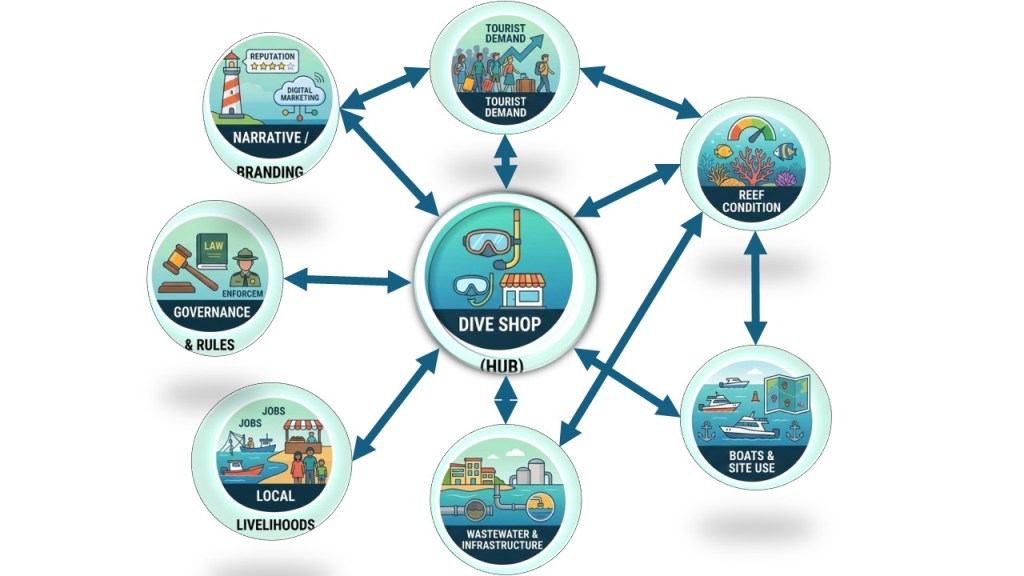
A dive shop is not next to the reef. It is inside the reef system.
That one shift changes the entire conversation. A dive operation does not simply bring people to a reef. It influences how people enter the water, what standards are normalized, what pressures accumulate, who benefits, who carries risk, and whether stewardship becomes real practice or remains mostly language.
Visual system map
Before going into the case, use this map as a simple lens. A dive shop sits inside a web of relationships, not beside them.
The six lenses
As you work through the case below, keep these six lenses in mind. The goal is not to become abstract. The goal is to become more precise.
1. Ecology: What is happening to reef condition, fish life, coral structure, resilience, and recovery?
2. Tourism use: How are dive sites used, by whom, how often, and with what standards?
3. Waste and infrastructure: What hidden systems sit behind the tourism model: wastewater, runoff, fuel, plastics, freshwater use?
4. Livelihoods: Who benefits economically? Who depends on tourism? Who becomes vulnerable if the reef or the market shifts?
5. Governance: Who shapes decisions? What rules exist? Who is heard, and who has weaker voice?
6. Narrative: What story is being told about the reef and the tourism model, and what does that story hide?
Case study: Blue Current Dive Co.
At first sight, Blue Current looks like exactly the kind of dive shop many thoughtful divers would want to support.
Blue Current at first sight
Blue Current is small-scale, well-liked, and conservation-minded in tone. Guests appreciate the warm atmosphere, the local knowledge, and the visible language of care. Compared to mass-market dive tourism, it feels personal, thoughtful, and more responsible. The reef still looks good enough that many visitors leave impressed.
Where pressure begins to show
Underneath that attractive surface, signs of pressure are accumulating. Experienced eyes notice fewer large fish than before, broken coral patches near the main moorings, and a sense that the reef is becoming thinner. The same popular sites are used repeatedly because they are close, easy, and marketable. During busy periods, group size rises. The island’s wastewater systems have not kept pace with tourism growth.
A reef can remain photogenic while becoming more fragile.
Who shapes the system
Consultation exists, but participation appears partial and late. This weakens legitimacy. Local people do not all carry the same voice in shaping tourism decisions, and visible care inside the dive operation does not automatically mean good governance around it. The values of the shop may be sincere, yet the wider system remains only partly governed.
The credibility question
Blue Current is not a cartoon villain. It may be more thoughtful than many alternatives. But that does not automatically make it a credible stewardship model. The harder question is not whether it cares. The harder question is: what system is it helping reproduce?
Care matters. But care without evidence, thresholds, and legitimacy is not yet a management system.
Pause and Think
If you were a guest, would Blue Current look like a responsible operator to you?
Why?
Keep your answer short before continuing.
Test your reading of the case
Use the questions below to move from impression to analysis.
Questions
- Where does the stewardship story seem stronger than the evidence behind it?
- What kind of shop does Blue Current seem to be at first sight?
- What is pushing the system?
- What pressures are accumulating?
- Who shapes decisions, and who has less voice?
Apply the lens
Ready to go one step further? Use the worksheet to map drivers, pressures, actors, and leverage points in the Blue Current case.
Estimated time: 10–15 minutes
Coming next
The next lesson moves from systems insight to a sharper question: we need to ask how it is experienced by different people within it.
 Bart Vander Plaetse